
‘Nouvelle Vague’ Goes Behind the Curtain
Not to compare myself to one of the greatest actresses of her generation, but I must say that I felt a bit like Jean Seberg while watching this movie.
Nouvelle Vague, directed by Richard Linklater, was the first of five movies that I attended for the 41st Miami Film Festival GEMS. The film captures the process of making Jean-Luc Godard’s first major film, 1960’s Breathless, one of the most influential films of the French New Wave. Starring Guillaume Marbeck, Zoey Deutch, and Aubry Dullin as Godard, Jean Seberg, and Jean-Paul Belmondo respectively, Nouvelle Vague peeks behind the curtain, showing the production of Breathless through its five stages (as a friend reminds Godard, those are writing, casting, filming, editing, and releasing).
My overall review of the movie is quite positive. Nouvelle Vague was described as a love letter to Godard, his films, and his process, and every frame shows Linklater’s clear admiration of and dedication to Godard’s work. In every aspect, he breathes the New Wave style and era, employing a variety of typical homages from the genre and starring film. Most notably, Linklater shot entirely in black and white 35mm film and used the same handheld Cameflex camera model employed by Breathless cinematographer Raoul Coutard. He also employed name cards to introduce new characters, used quick editing and jump cuts, and largely shot on location in Paris.
During the film, the cast and audience alike were both bewildered and entranced by Godard’s process of making Breathless.
He directs with a firm hand then none at all, tosses out starting lines but refuses to provide a script, utterly disregards lighting conditions but trusts the cameraman implicitly. At times it is impossible to understand his motivations, and the crew doesn’t hesitate to tell him so. Despite his infuriating tendencies, everyone slowly slips under his spell, though not without attempting to keep his feet on the ground. The dialogue is as fast and clever as the camerawork; the cast and crew’s teasing and riffing off each other, Godard’s unceasing catalogue of quotations, the full-circle teasing pronunciation of Breathless as “utter shit” and “worst film of the year” by Godard’s critic friends, all pulled laughter across the theatre throughout the screening.
I said I felt a bit like Jean Seberg because we both spent the film a few steps behind. Going into both Nouvelle Vague the film and Nouvelle Vague the genre completely blind left me on the back foot, trying to take in faces and names I did not know, but whose presence rippled onscreen with historical weight. The unfamiliar American, whirling around, deciphering all of these riddles, missing vital threads of context, was a scene mirrored on the screen and in my seat.
However, I said I felt a little bit like Jean Seberg, because unlike her, I enjoyed the ride.
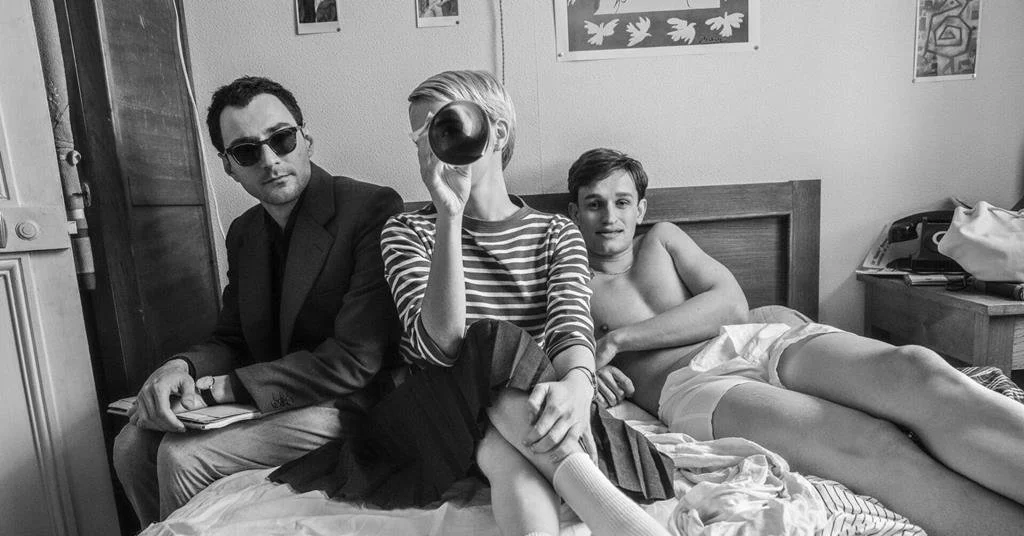
‘Nouvelle Vague’ still of Jean-Luc Godard (Marbeck), Jean Seberg (Deutch), and Jean-Paul Belmondo (Dullin).
With a background focused on architecture more than cinema arts, I cannot embellish this interview with encyclopedic commentary on the French New Wave. I can, however, commend the spatial dimension of this film.
There has been growing criticism in recent years about the over-polished quality of design in many recent productions. Think back to the last Netflix original movie you suffered through— costuming that seems off the racks of Spirit Halloween, rigidly staged sets, an overreliance on computer generated imagery and underuse of practical effects. And that’s on top of the terrible script.
Nouvelle Vague does not suffer from these issues.
To start, any artist, architect, or designer worth their salt would be able to point out the benefits of shooting a film in Paris. It is a city with infinite layers and textures to draw on, from cobblestone streets to stone entablatures to swirling metro signs, and it becomes a character in itself. Nouvelle Vague is as much a love letter to the Paris of the 1960s as it is to Breathless, showing it in all of its multi-faceted glory.
The backdrop of the city paired with the sumptuous interior sets are perfectly imperfect. The elegant wallpaper, high ceilings, and scattered papers of the Cahiers du Cinéma office, the pinball machine and tiled floor of Godard’s favorite café haunt, the beaten cobblestones boulevards– I could go on for days. Linklater crafted a movie that feels lived in, and invites the audience to step over the threshold, pushes and pulls you through each scene. Viewers begin squeezed between crowds in a flickering theater. They shiver on a terrace with curling smoke and midnight skies, pack with the crew into a rumpled hotel room, watch a lone figure running across a field at twilight, and breathe in the serenity of a harbor at dawn. It makes for a picture that is a visual delight.
The film has a remarkable physicality to it, largely derived from the handheld, documentary-style camerawork and snappy editing. As Linklater trails one step behind Godard, we watch how the revolutionary director develops his unconventional vision. Breathless (and Nouvelle Vague) did not succeed solely by virtue of the unique acting and writing, but through every single captured frame. Seen dangling from balconies, bundled into a postal cart, and rolled in a wheelchair by Godard himself, cinematographer Raoul and his handheld camera are directed too.
It's impossible to not join them on the ride.
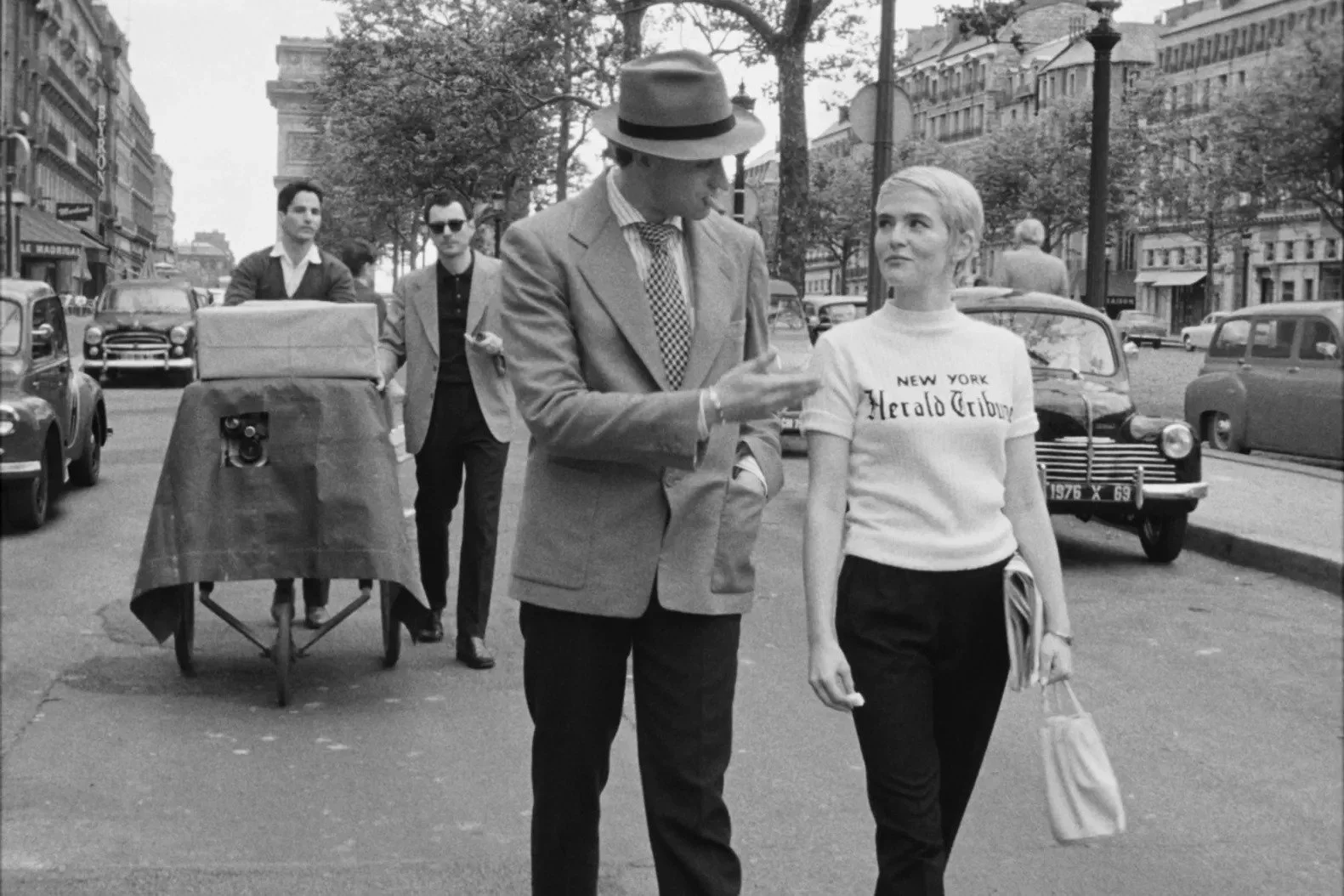
Godard and Claude Beausoleil push Raoul Coutard in a covered cart, filming Belmondo and Seberg in a street scene.
In one scene, Godard says to his friends that it is almost impossible to adapt a book to a movie. A friend follows up asking if he could adapt the Bible. Godard responds that he could, but that he would not film the Bible as it is in the text, but instead “I would film all of the moments in between.”
It all comes down to that— Breathless is Linklater’s Bible, Nouvelle Vague is the in between.